
Learning and Development Opportunities for Researchers and Trialists
The Network, and its member CTUs, are committed to sharing their knowledge of best practice in clinical trials research from the absolute fundamentals of trial development and management to the use of the latest novel trial designs.
Below you can find out about some of the upcoming learning and development opportunities taking place across the Network.
Some events are open to all and allow for online registration and payment. Others are limited to staff at Registered CTUs.
Use the links below to find out more.

September 2026
Title: Randomised Controlled Trials: A Guide to Design, Conduct, Analysis, Interpretation, and Reporting
Date: 7 – 11 September 2026
Venue: Merton College, University of Oxford
Cost: £1,850 per person
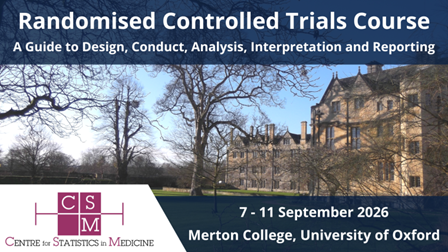
The Centre for Statistics in Medicine (CSM)’s Randomised Controlled Trials (RCT) Course is ideal for anyone planning or actively involved in RCTs for healthcare evaluation, particularly those early in their career or looking for a refresher course. This 5-day course uses a problem-based learning approach to provide a thorough grounding in the principles and practice of planning, conducting, analysing, reporting, and interpreting RCTs, mixing lectures and small-group practical work. The interdisciplinary faculty includes registered CTU directors, clinicians, and statisticians, all with a wealth of RCT experience.
Course objectives:
* Clarify the fundamental principles and practice of RCTs
* Present the optimal methodology to use in RCTs
* Examine the critical issues involved in planning, conducting, and completing a successful trial
* Provide a basic understanding of the statistics used to plan and analyse RCTs
* Teach critical appraisal skills and practice appraising RCT papers
Who should attend:
If you are planning or actively involved in trials, or are interested in furthering your knowledge of trial methodology, this course is for you. It is ideal for those early in their career or those looking for a refresher course, as it provides an overview of all elements of an RCT. We welcome applications from clinical and non-clinical researchers and other professionals allied to medicine.
Course fees: £1850. Fees include daily lunch and refreshments, a course dinner (Thursday evening), and a comprehensive delegate’s pack including all course materials.
Title: Introduction to Cancer Clinical Trials
Date: 22 September 2026
Venue: Cancer Research UK & UCL CTC, 149 Tottenham Court Road, W1T 7N
Cost: £50 (non-profit organisations) £100 (for-profit organisations)
Course lead: Giulia Pellizzari, Lecturer, CR UK & UCL CTC
This session provides a general introduction to cancer clinical trials for staff new to academic cancer studies.
Participants will get an overview on what clinical trials are and how they can have a preventative, curative or palliative aim. The session covers the practical and scientific reasons why we need clinical trials, what are the differences between Phase I, II, II and IV studies and the different methods of randomisation. The session also highlights how drug development trials in cancer differ from non-cancer studies and how the new era of targeted therapy and immunotherapy is changing the way cancer trials are designed.
Please note that the course will run between 10.00am until 13.00pm.
For further information, and to register, please click here.
Title: Modern Dose-finding Designs in Early Phase Trials
Date: 30 September 2026
Venue: The ICR, 123, Old Brompton Road, London SW7 3RP
Cost: £120 (academics) £180 (non-academic)
Course lead: Christina Yap, ICR-CTSU Early Phase and Adaptive Trials Group
Join us for a practical, one-day workshop built for clinicians and non-statisticians working on early-phase trials.
You’ll learn how model-based and model-assisted designs work in practice, walk through real case studies, and take part in an interactive mock Safety Review Committee (SRC) exercise. The workshop will help you confidently interpret trial outputs, make dose decisions, and communicate the rationale behind those decisions.
No prior statistical knowledge required. By the end of the day, you’ll be able to:
* Describe how modern dose-finding designs are used in early-phase clinical trials.
* Understand how Bayesian methods are used to guide dose-escalation decisions in early-phase trials.
* Interpret key outputs and recommendations from dose-finding studies.
* Critically evaluate and discuss dose-escalation and dose-selection decisions in an SRC setting.
* Follow best practices for communicating and reporting dose-escalation decisions to regulators, trial teams, and in scientific publications.
Please note that the course will run between 09:30 until 16.00.
To register, please click here.
Title: How to Set Up a Clinical Trial
Date: 30 September, 7 October, 14 October, & 21 October 2026
Venue: Online via Blackboard
Cost: £450
Course facilitators: Carla Girling, Katie Biggs, Kirsty McKendrick, Cara Mooney, & Emily Turton
About the course*
This short course runs across four half days and will focus on the processes surrounding the set up of a clinical trial, from the point at which funding has been awarded to opening the first research sites. Through a combination of online teaching, group and individual activities, you will be taken through a practical step by step guide on the processes and dependencies in trial set up. To enhance the experience of the course we recommend you come with a project in mind (although examples will be given throughout for those who are new to research/clinical trials). *Please note that this course does not cover how to design a clinical trial.
Who will benefit from the course?
The course is ideal for researchers from across the UK looking to set up a clinical trial (within the NHS). The general skills and processes are also applicable to research with human participants outside of the NHS. Research assistants, new trial managers, PhD students, research fellows and associates, among others, would all benefit from the knowledge and skills learnt during the course. Please note that this course is aimed at those working on UK-based clinical trials due to the UK’s unique framework of rules.
For further information, and to register, please click here.
Can’t make these dates? Please register your interest here and we will be in touch when we have new dates.
October 2026
Title: Improving Clinical Trial Delivery: Investigator Site Staff
Date: 12 – 13 October 2026
Venue: Online (University of Birmingham)
Cost: £250 person
This two day programme is designed to build understanding and efficiency in the ongoing site management and delivery of open trials. It is aimed at site delivery staff. The teaching will be delivered through a combination of pre-recorded lectures; independent reading and live online sessions.
For sites to achieve their recruitment target on time, in compliance with the trial protocol and with the collection of complete and accurate data, experienced and trained staff are required. This 2-day programme will focus on the management of trials from the perspective of the Principal Investigator and the site delivery team. It will explore clinical trial challenges such as the factors that can affect successful participant recruitment, data quality and the challenges in the assessment and reporting of safety data. It will focus on the impact of protocol deviations on patient safety and data credibility and will improve comprehension of the rationale for specific trial activities.
For further information, and to book your place, please click here.
Title: Navigating Cancer Trials: Essential Knowledge
Date: 13 – 14 October 2026
Venue: Cancer Research UK & UCL Cancer Trials Centre, London
Cost: £50 person
Aims
To provide participants with a practical introduction to the biology, diagnosis, staging, and treatment of cancer, and to explain how these inform the design, conduct, assessment, analysis, reporting, and oversight of cancer clinical trials. The course will focus on the core concepts underpinning key trial outcomes, including adverse events, response, survival, and other time-to-event endpoints. It will also provide an opportunity for attendees from a range of professional backgrounds to share experience and build connections across the cancer trials community.
Learning Outcomes
By the end of the course, participants will have a better understanding of the clinical and trial-related data that contribute to cancer trial design, conduct, analysis, and reporting, and of the principles for interpreting and presenting these data. In particular, participants should be able to demonstrate greater knowledge of:
* cancer biology and its relevance to treatment selection, tumour spread, and outcome assessment
* cancer diagnosis and staging, and their implications for screening, eligibility criteria, and trial entry
* commonly reported patient and tumour characteristics, including considerations in selecting stratification factors
* cancer treatments, including practical issues in documenting and reporting treatment delivery and protocol compliance
* adverse events associated with cancer therapies, and principles for their assessment and reporting
* response assessment in solid tumours and haematological malignancies, and the reporting of response-based endpoints
* survival and other time-to-event endpoints commonly used in cancer trials
* challenges arising in trials of novel therapies, including targeted agents and biomarker-informed treatments
For further information, and to book your place, please click here.
Title: Running a trial from concept to completion
Date: 15 October 2026
Venue: Cancer Research UK & UCL CTC, 149 Tottenham Court Road, W1T 7N
Cost: £50 (non-profit organisations) £100 (for-profit organisations)
Course lead: Rubina Begum, Senior Project Manager, CR UK & UCL CTC
This session gives an introductory overview of all the steps required to design, set up and complete an academic cancer trial conducted in the hospital setting.
Participants will know what all the organisations and people involved in trials do and what permissions and documents need to be in place at different stages of a trial. The course is of most interest to those new to working in academic cancer clinical trials. Those currently working in the field who would like to gain an overview of what happens at other stages to the one familiar to them, may also benefit.
Please note that the course will run between 10.00am until 13.00pm.
For further information, and to register, please click here.
Title: Using healthcare systems data in clinical trials: Data Utility Comparisons – DUCkS Workshop
Date: 22 October 2026
Venue: 90 High Holborn, London WC1V 6LJ
Cost: Free (see note below)
Course lecturers: Dr Macey Murray, Sharon Love, Prof Matt Sydes, Dr Jemima Thompson, & Gabriela Toledo
The use of health systems data (aka routinely-collected healthcare data, such as Hospital Episode Statistics) as trial data could transform the delivery of clinical trials, but there are key challenges to address. One of the challenges is assessing the suitability of the data to replace trial-specific data collection and its relevance, which we refer to as its utility. To have utility, we need to be assured that health systems data sufficiently captures the data traditionally reported on case report forms. We assess utility through the comparison of health systems data with trial-collected data. These formal comparison studies will provide evidence on the fitness of purpose of a dataset to answer specific questions.
In this workshop, we will be showcasing some utility comparisons, explaining their need, presenting our suggestion for how to conduct one, and giving some space for you to plan your own utility comparison.
For more details on DUCkS, please read Sydes et al. ‘Getting our ducks in a row: The need for data utility comparisons of healthcare systems data for clinical trials’ (doi: 10.1016/j.cct.2024.107514).
This workshop is being run as part of the HDR UK Transforming Data for Trials programme (2023-2029).
Target Audience
Researchers and statisticians who want to use healthcare systems data in a clinical trial.
Fees
The workshop is free. However, it is likely to be oversubscribed – in this case the attendees will be selected based on their registration. A waiting list will be maintained and spaces allocated subject to any cancellations.
For further information, and to book your place, please click here.
November 2026
Title: An Introduction to Design and Analysis of Clinical Trials: Statistics for Non-Statisticians
Date: 2 – 5 November 2026
Venue: Via Zoom (09:30 – 12:45)
Cost: £130 – Low & Middle Income Countries (LMIC), £245 – Academic / not-for-profit organisations, £320 – for-profit organisations
Course facilitators: Dr Laura Murphy, Yath Yogeswaran (UCL Innovative CTU)
This four-day course will provide an introduction to the principles and application of statistics in the randomised controlled trial (RCT) environment. It will explain what’s important and why, and enable understanding of statistical methods and analyses in RCTs.
Intended audience
Non-statisticians working in clinical trials who only have a basic level of statistical knowledge at present and wish to be more familiar with the meanings of common statistical terms used in clinical trials and the interpretation of results. Generally this course is aimed at people with less than 3 years’ experience in a Clinical Trials setting, although all applicants are welcome.
For further information, and to book your place, please click here.
Title: Introduction to Clinical Trials
Date: 2 – 27 November 2026
Venue: Online via Teams
Cost: From £180 per person. Early bird rates available until 2 October 2026
Course leads: All sessions on the course are delivered by experienced trialists and professional staff from Nottingham Clinical Trials Unit
The Introduction to Clinical Trials course offers a comprehensive and practical introduction to the design and conduct of randomised clinical trials (RCTs). Through a combination of flexible online learning and interactive tutor-led sessions, students will gain an understanding of the key principles that underpin high-quality clinical research and the evaluation of healthcare interventions. It is ideal for healthcare professionals, researchers, trial staff, statisticians, clinicians, and anyone involved in the planning, delivery, analysis, or review of clinical research.
The course focuses primarily on large, multicentre randomised clinical trials, including both drug trials and trials of complex interventions. It does not cover non-randomised studies, observational research designs, or trials evaluating diagnostic tests.
The course is delivered entirely online through Microsoft Teams and runs over four weeks, with a mixture of pre-recorded lectures, live online tutor-led sessions, and supporting resources and self-directed learning activities.
For further information, and to book your place, please click here.
Title: Entering patients into cancer clinical trials
Date: 10 November 2026
Venue: Cancer Research UK & UCL CTC, 149 Tottenham Court Road, W1T 7N
Cost: £50 (non-profit organisations) £100 (for-profit organisations)
Course lead: Laura Hughes, Trial Manager, CR UK & UCL CTC
This session gives a comprehensive overview of the clinical pathways cancer patients can take to be eventually referred for trial entry.
The first part of the session spans across the diagnostic methods and staging of cancer and gives a brief overview of the common tests carried out prior to trial treatment. In the second part of the session participants will learn about the importance of ensuring only eligible patients enter a trial and how eligibility criteria help to safeguard patients and differ amongst different phases of trials. They will also learn the importance of assessing treatment compliance and how every clinical intervention comes with a different set of challenges in collecting data about patient compliance.
Please note that the course will run between 10.00am until 13.00pm.
For further information, and to register, please click here.
Title: Clinical Trial Management: Maximising Effectiveness
Date: 16 – 17 November 2026
Venue: Birmingham
Cost: £250 per person
Course lead: Razia Meer-Baloch (Birmingham CTC)
This two-day programme will focus on the fundamentals of the project management of trials. The teaching will be delivered through a combination of pre-recorded lectures; independent reading and live online sessions.
Trials that are successfully delivered on time and to the recruitment target require the employment of good project management. High quality data is driven through data and quality management processes, and these must be combined with an understanding of the trial safety reporting requirements, and the ongoing assessment and evaluation of trial risks.
The programme will explore how to plan for and respond to clinical trial challenges, maximising effectiveness, efficiency and data quality. It is aimed at individuals involved in trial co-ordination and management who have some experience, and who would like to build on this skill set.
For further information, and to book your place, please click here.
Title: CAR-T cell therapy in cancer clinical trials: manufacturing, regulations and clinical implementation
Date: 18 November 2026
Venue: Cancer Research UK & UCL CTC, 149 Tottenham Court Road, W1T 7N
Cost: £25 (Clinical Trials Units), £50 (non-profit organisations), £100 (for-profit organisations)
Course aim
This course offers a thorough exploration of CAR-T cell therapies (Chimeric Antigen Receptor T cell) within the realm of clinical trials. Participants will delve into the historical background of CAR-T therapies, their classifications, regulatory frameworks, safety considerations, mechanisms of action. Additionally, the course emphasizes Good Manufacturing Practice (GMP), addressing essential considerations, manufacturing processes, and quality control. By the end of the course, participants will have a solid understanding of CAR-T therapies in the context of clinical trials, including practical insights into managing CAR-T cell therapy trials and an overview of their clinical implementation.
Please note that the course will run between 09.30 until 16.15
For further information, and to register, please click here.
Title: Cancer treatments and their side-effects
Date: 19 November 2026
Venue: Birmingham
Cost: £250 per person
Course lead: Razia Meer-Baloch (Birmingham CTC)
This two-day programme will focus on the fundamentals of the project management of trials. The teaching will be delivered through a combination of pre-recorded lectures; independent reading and live online sessions.
Trials that are successfully delivered on time and to the recruitment target require the employment of good project management. High quality data is driven through data and quality management processes, and these must be combined with an understanding of the trial safety reporting requirements, and the ongoing assessment and evaluation of trial risks.
The programme will explore how to plan for and respond to clinical trial challenges, maximising effectiveness, efficiency and data quality. It is aimed at individuals involved in trial co-ordination and management who have some experience, and who would like to build on this skill set.
For further information, and to book your place, please click here.
Title: Research Methods: Introduction to Randomised Controlled Trials in Healthcare
Date: 23 – 25 November 2026
Venue: Edgbaston Campus, University of Birmingham
Cost: £600 per person
Course leads: Razia Meer-Baloch (Birmingham CTU) and Dr Sara Brookes (CRUK CTU)
Clinical trials have huge societal impact, providing the best evidence of the effectiveness of healthcare, social care and public health interventions. Research through clinical trials is a growing global business in academic institutions, industry, the NHS and across public health organisations. To ensure efficient trials that reach successful completion, trial staff require a solid grounding and knowledge of the design, conduct, analysis and interpretation of clinical trials.
This face-to-face 3-day course in Research Methods: Introduction to Randomised Controlled Trials in Healthcare organised by the Birmingham Centre for Clinical Trials (BCCT) provides an overview of the research process from idea and design to analysis and publication. This programme will be designed to combine theory with opportunities to apply knowledge to practice, and will be delivered in person with additional access to recordings and self guided readings.
Birmingham is well recognised for its research methods teaching with over 20 years’ experience of delivering short course CPD teaching in research methods, in addition to running a Master’s programme in Clinical Trials (MSc/PGDip/PGCert).
For further information, and to book your place, please click here.
Title: An Introduction to Pragmatic Clinical Trials
Date: 24 – 25 November 2026
Venue: London
Cost: £350
Course leads:
The course will provide an introduction to the principles of pragmatic trials, including their design and analysis. It will introduce strategies to optimise trial conduct, including consent, recruitment and data collection and highlight the importance of patient and community involvement. Participants will have an opportunity, in facilitated sessions, to work up an outline protocol for a pragmatic trial.
This introductory course would be suitable for early/mid-career researchers working in clinical research in academia or the NHS. It is open to those working across a range of research roles, including trial or data managers, principal / chief investigators etc, and does not require detailed knowledge of statistical methods.
For further information, and to book your place, please click here.
Title: Statistical and practical aspects of the design and analysis of Multi-Arm Multi-Stage (MAMS) Platform Trials
Date: 25 November 2026
Venue: Via Zoom (12:00 – 17:00)
Cost: £107 – Low- & Middle- Income Countries (LMIC), £214 – Academics / from not-for-profit organisations, and £257 – for-profit organisations
Potential Attendees:
This workshop is aimed at trial statisticians, regulators and clinicians who want to understand more about the design and analysis of multi-arm multi-stage (MAMS) platform trials, or those who are new to the area. This includes statisticians looking to design MAMS platform trials, or clinicians and researchers wanting to understand the statistical issues in designing such trials in the phase III setting.
There will be an opportunity for delegates to send questions in advance so that they can be addressed at the workshop.
The workshop aims to help participants:
- understand the motivation behind these designs
- learn how to choose the design parameters and stopping boundaries, both for lack-of-benefit and efficacy
- learn how to deal with overwhelming efficacy
- learn about stopping randomisation to research arms
- learn how to add a new research arm, and how to control Type I and II error rates in both pre-planned and unplanned addition of a new research arm
- learn about MAMS designs in which arms are ranked and selectively chosen to continue
- learn how the programs written in Stata software can be used to design MAMS trials with time-to-event and binary outcomes
MAMS platform trials:
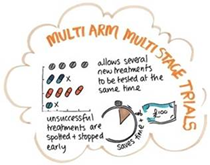
Typically, in these protocols, randomisation is stopped to insufficiently active treatment arms at interim stages and new research arms can be added during the course of the trial. MRC Clinical Trials Unit at UCL is a leader not only in the design, but also in implementation and analysis of such trials. The MAMS approach is one of the few adaptive designs being deployed in a number of trials and across a range of disease in the phase III setting, including STAMPEDE (prostate cancer), CompARE (TB), TRUNCATE-TB (TB), RAMPART (renal cancer), and ROSSINI-II (wound surgery) .
Structure of the workshop:
This half-day workshop consists of two main sessions. The first session of the workshop provides an overview of the design issues involved in MAMS platform protocols. The second session focuses on the implementation of the statistical aspects of such trials and provides guidelines on the design and analysis of such trials. It will also explore further design issues such as adding new research arms, and designs in which research arms are ranked and selectively chosen to continue.
Software and examples:
In both sessions, the methods are explored using real platform trial examples, and using programs written in Stata software – i.e. the nstage suite in Stata for trials with binary and time-to-event outcomes, which can be usefully partnered with artpep for time-to-event projections.
The workshop concludes with a discussion session when participants have the opportunity to discuss specific design and analysis questions with the panel. For this reason, we encourage those planning to attend the workshop to submit their questions to the above email in advance, any time after registration.
Faculty will include: Dr Babak Choodari-Oskooei, Professor Mahesh Parmar
Please click here to register.
For further information, and to book your place, please click here.
Title: Knowledge Mobilisation in Research
Date: 30 November 2026
Venue: Online
Cost: £250
Course organisers: Dr Helen Baxter, Professor Sabi Redwood and Dr Clare Thomas
The National Institute for Health and Social Care Research (NIHR), as well as other funders, are increasingly requiring Knowledge Mobilisation approaches to be incorporated into research grant applications to strengthen pathways to impact. Knowledge mobilisation is used to share knowledge between different communities, to create new knowledge and catalyse change.
Academics at the Applied Research Collaboration South West have been exploring and developing these approaches for the past decade and have worked with colleagues at the NIHR. This course will introduce the key concepts and definitions in the field and the latest developments. It will also take attendees through the process of designing a Knowledge Mobilisation plan for a research project.
For more information, and to register, please click here.
December 2026
Title: Trial outcomes: what are we trying to measure?
Date: 1 December2026
Venue: Cancer Research UK & UCL CTC, 149 Tottenham Court Road, W1T 7N
Cost: £50 (non-profit organisations) £100 (for-profit organisations)
Course lead: Will Wilson, Senior Research Fellow – Senior Medical Statistician
This session, aimed at non-statisticians, will cover the most common primary outcomes measures used in early and late phase cancer trials.
Participants will learn what makes a good outcome measure, how outcomes measures are defined and what data need to be collected to assess the outcome, especially for tumour response assessment and time to event measures such as survival and disease (or progression) free survival.
Please note that the course will run between 10.00am until 13.00pm.
For further information, and to register, please click here.
Title: Qualitative Methods in Clinical Trials
Date: 2 – 4 December 2026
Venue: Nottingham
Cost: From £240 per person. Early bird rates available until 4 November 2026
Course leads: Paul Leighton, Kirsty Sprange, Rachel Evley, Louise Thompson, & Amy Fuller
This three-day course provides a practical introduction to the use of qualitative research within clinical trials and feasibility studies. Delegates will explore how qualitative methods can be used to optimise intervention development, improve recruitment and retention, enhance trial delivery, and support interpretation of trial findings.
Through a combination of expert-led teaching, practical exercises, real-world case studies and discussion, participants will develop an understanding of the theory underpinning qualitative research and gain confidence in designing, conducting and evaluating qualitative components within clinical trials.
For further information, and to book your place, please click here.
January 2027
No events are currently listed.
February 2027
Title: Practical use of multiple imputation to handle missing data in Stata
Date: 9 – 12 February 2026
Venue: Online via Zoom
Cost: Early Bird Offer: £161 – LMIC Countries; £327 – Academic/not-for-profit; £394 – Attendees from or-profit organisations / Standard fees (after 1 September 2026): £175 LMIC Countries; £355 – Academics/not-for-profit; £428 – Attendees from for-profit organisations.
Course leads: Ian White (UCL Innovative CTU), Angela Wood (University of Cambridge), Tra My Pham (UCL Innovative CTU)
Our aim in this course is to provide participants with the ability to analyse their own data using multiple imputation, but also to be aware of the pitfalls and limitations of the technique. We will give plenty of practical examples from our own experience of analysing data in medical research. We welcome participants bringing their own data and problems.
This course is loosely based on our tutorial in Statistics in Medicine.
Target audience
The target audience is researchers needing to analyse incomplete data:
* Attendees are expected to be familiar with running Stata from the command line (i.e. not using menus) at least to the level of fitting a regression model to complete data and producing simple graphs
* No prior knowledge of multiple imputation is assumed.
Find out more, and register, here.
March 2027
No events are currently listed.
May 2027
No events are currently listed.
June 2027
No events are currently listed.
July 2027
No events are currently listed.
August 2027
No events are currently listed.
September 2027
No events are currently listed.
Flexible Online Training
Title: Introduction to Randomised Controlled Trials
Date: Anytime
Venue: Online course on FutureLearn
Cost: Available via subscription
Course Lead: Razia Meer-Baloch, Birmingham CTU
Discover the importance of trials in evidence-based medicine and learn about the trial lifecycle from conception to publication.
This course has been built by a team of expert research trial staff from the Birmingham Centre for Clinical Trials within Birmingham University. This team will guide you through the entire process for conducting randomised controlled trials and how to report results that can then be used to inform guidelines.
This course is designed for new or existing clinical trial staff. It may also be of interest to anyone looking to learn more about the wider randomised controlled trials process.
For further information, and to register, please click here.
Title: Introduction to Data Management in Clinical Research
Date: Anytime
Venue: Online course on FutureLearn
Cost: Available via subscription
Course Lead: Razia Meer-Baloch, Birmingham CTU
Improve the quality of medical research with clinical data management tools to collect, manage, and store trial data effectively.
This introductory course is for anyone setting up clinical trials and responsible for ensuring trial data integrity, such as aspiring chief investigators, trial coordinators, managers, data managers, and administrators. No prior knowledge is needed to join.
For further information, and to register, please click here.
Title: Statistics in Clinical Trials for the Non-Statistician
Date: Anytime
Venue: Online course on FutureLearn
Cost: Available via subscription
Course Lead: Sara Brookes, CRUK CTU
Discover the crucial role statistics plays in clinical trials and enhance your understanding of clinical trial data and analysis.
This course is ideal for individuals involved in clinical trials, whether in academia or the NHS, as well as those without a background in statistics. This includes aspiring chief investigators, research nurses, trial coordinators, trial managers, data managers, quality assurance team members, trial administrators, and other members of trial teams such as qualitative researchers or health economists.
The course is introductory with no prior knowledge or experience of statistics required.
For more information, and to register, please click here.
Post-Graduate Degrees
Title: Clinical Trials MSc/PGDip/PGCert
Institution: University of Birmingham
Teaching Staff: Razia Meer-Baloch, Birmingham CTU and Sara Brookes, CRUK CTU
This Master’s degree (Also available as a postgraduate diploma and certificate with modules available as standalone options) provides students with an excellent foundation in clinical trials, covering the theoretical and practical aspects of the design, conduct, analysis and interpretation of clinical trials, promoting efficient trials that reach successful completion. The programme aims to produce skilled specialist trials staff in the existing workforce and expert trial Chief Investigators of the future.
This course will run over 12 months in a full-time-mode. There’s also scope to undertake the programme on a part-time basis or flexibly (up to 5 years).
For further information please click here.