
For World Patient Safety Day 2026, Claire Brooks, Pharmacovigilance Manager of the Oncology Clinical Trials Office at the University of Oxford looks at how pharmacovigilance and Clinical Trials Units (CTUs) can help manage uncertainty and protect participants as novel approaches to cancer prevention move into clinical trials.
World Patient Safety Day 2026 focuses on safe care for people living with noncommunicable diseases, including cancer.
Clinical trials are fundamental to improving that care, helping us understand not only whether new interventions work, but also how safely they can be used.
Pharmacovigilance (PV) – the detection, assessment, understanding and prevention of adverse events and other medicine related problems – is central to this process.
Copyright © University of Oxford Images /
John Cairns Photography – All rights reserved.
One of the biggest challenges for PV arises when planning trials of novel interventions: how do we plan for risks that we do not yet fully understand?
This is particularly relevant to our work in precision prevention. Precision prevention in cancer research means using detailed biological and genetic data to intercept and stop cancer before it starts in high-risk individuals. Participants may have undergone curative intent surgery for early-stage cancer or carry an inherited genetic variant that increases their future cancer risk.
In conventional oncology trials, participants with advanced cancer are likely to already be seriously unwell and may receive treatments such as chemotherapy, with well-characterised toxicities. In a prevention trial, one of the challenges is that these populations are neither healthy volunteers nor people with active disease; the intervention is intended to prevent. There is therefore a particularly low tolerance for treatment related harm.
Copyright © University of Oxford Images /
John Cairns Photography – All rights reserved.
At the same time, our preventive interventions are novel and entering first-in-human (FIH) studies, meaning that initially there is limited human safety information available. This uncertainty appropriately leads to a cautious approach to safety monitoring, even where the actual level of risk to participants is not yet known.
This highlights an important distinction: uncertainty about risk is not necessarily the same as evidence of high risk.
Three vaccine trials supported by the Oncology Clinical Trials Office (OCTO) illustrate the challenge.
LungVax is investigating a ChAdOx2-based vaccine designed to prevent or delay recurrent or new non-small cell lung cancer in people at increased risk. Although its use in this setting is novel, the ChAdOx2 technology builds on Oxford’s experience with viral-vector vaccines.
Learn more about LungVax here.

INTERCEPT-Lynch presents a different situation. It is testing mRNA-4194 in people with Lynch syndrome, with the aim of training the immune system to recognise and remove abnormal cells before they develop into cancer.
The study is the first time mRNA-4194 has been given to people, meaning that its side-effect profile is necessarily uncertain.
Learn more about INTERCEPT-Lynch here.
VISTA, meanwhile, is evaluating ITOP1, another first-in-human cancer vaccine, but in people with resectable oesophageal cancer receiving chemotherapy and surgery.
Its Phase I safety lead-in involves eight participants receiving staggered vaccine doses, with safety assessed before the trial progresses to its randomised Phase II stage.
Learn more about VISTA here.

All three involve novel cancer vaccines, but their participants, underlying health, accompanying treatments and existing knowledge about the interventions differ considerably.
This is why “novel” cannot, by itself, define the appropriate pharmacovigilance approach.
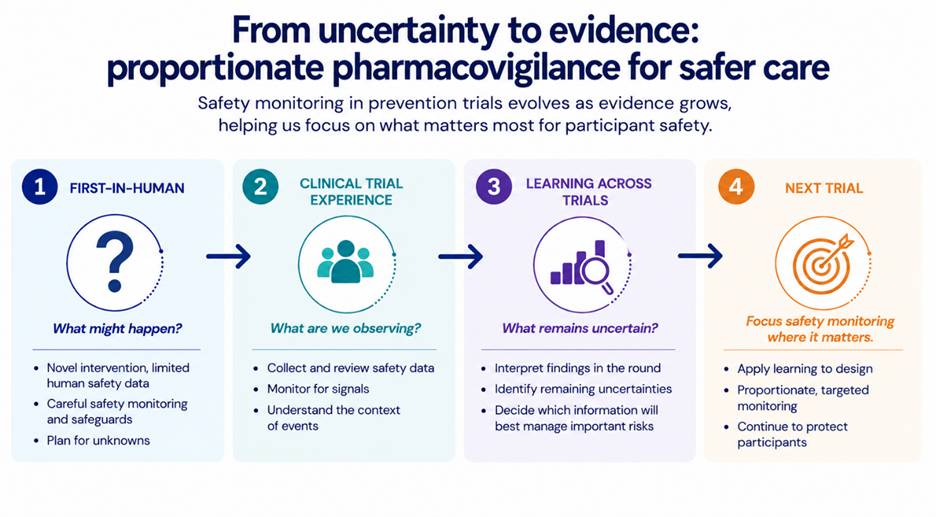
At the start of a trial, caution is appropriate. Trial teams must decide which adverse events to collect, how they will be assessed and reviewed, and which findings might require additional action or even a pause in treatment. But PV should not be static.
As participants receive an intervention, uncertainty gradually begins to be replaced by evidence. Sometimes that evidence may identify a potential risk requiring additional monitoring. Equally, accumulating experience may provide reassurance.
Good PV means being prepared to respond to both.
It can be tempting to assume that collecting more safety information automatically makes a trial safer. However, every reporting requirement creates work for participants, research sites and trial teams. The important question is therefore not simply “How much safety data can we collect?”, but “Which information will genuinely help us identify and manage important risks?”
Proportionate PV is not about doing less to protect participants. It is about focusing attention where it contributes most to their safety.
A low rate of SAEs may be reassuring, but it does not establish that the interventions are risk-free. Early phase trials involve relatively small numbers of participants, and rare adverse reactions may only become apparent after much greater exposure.
Nevertheless, an absence of SAEs is part of the accumulating safety evidence. The information available when planning a second or third trial is therefore different from that available before the first participant received the intervention.
This raises an important question: should our approach to safety monitoring remain unchanged as our knowledge of an intervention grows?
This is where the Clinical Trials Unit model is particularly valuable.
PV does not operate in isolation. CTUs bring together multidisciplinary expertise in trial management, statistics, data management, regulatory and quality requirements. This allows individual safety reports to be considered alongside accumulating trial data and the wider clinical picture.
Importantly, the learning does not end with an individual study. Experience from one trial should inform the design of the next, allowing assumptions made before first-in-human exposure to be revisited as evidence grows.
For novel interventions, we inevitably begin with uncertainty. Good pharmacovigilance means putting appropriate safeguards in place while remaining willing to adapt as knowledge develops.
By bringing together the expertise needed to interpret emerging safety information and carrying that learning from one trial to the next, CTUs can help turn uncertainty into evidence, and evidence into safer care.
To keep up to date with the work of the Network follow us on LinkedIn or Bluesky.



If you have any questions about the site, please feel free to contact us. We are always looking for ways to better serve our members - YOU are important to us!
If you have any questions about the site, please feel free to contact us. We are always looking for ways to better serve our members - YOU are important to us!